
INNOVATIVE DESIGNS, EXTRAPOLATION,
SIMULATION METHODS AND EVIDENCE-TOOLS
FOR RARE DISEASES ADDRESSING REGULATORY NEEDS
The INVENTS program focuses on advancing the future evaluation of treatments and the regulatory decision-making for rare diseases (RD) including paediatric rare diseases.
About rare diseases
European key figures

Up to
36 million
people are concerned in the EU

95%
of rare diseases
have no treatment option

There is more than
6000
distinct rare diseases

70%
of genetic rare diseases
starts in childhood
Challenges
Future assessments for rare diseases treatments face challenges :

A lack of clinical trials and sufficient evidence to decide for treatment

The heterogeneity of rare diseases

Outdated research infrastructures and approaches
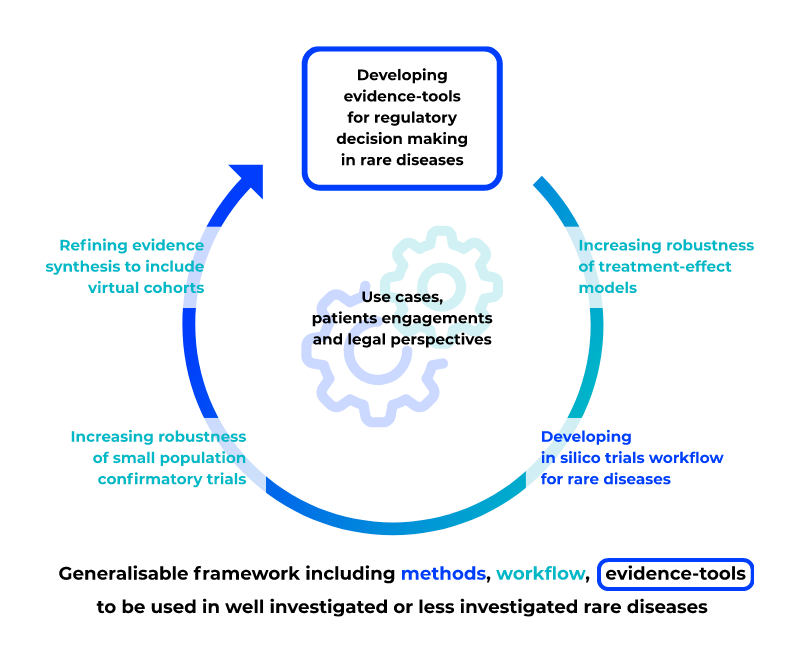
In a 5 years project, INVENTS aims to enhance decision-making by incorporating patient experiences, creating in silico evaluation models from clinical trial or real-world data, and developing regulatory decision support tools for regulatory agencies.
Ambition
INVENTS’ framework will enhance drug development, treatment safety and robustness in rare diseases.
News
![[Publication] Overview of Regulatory Guidelines Related to Methods and Models for Small Populations](https://invents-he.eu/wp-content/uploads/2024/05/header-contact-1024x256.webp)
[Publication] Overview of Regulatory Guidelines Related to Methods and Models for Small Populations
Overview of Regulatory Guidelines Related to Methods and Models for Small Populations Publication This paper provides an overview of approaches and related guidelines from the EMA, FDA, and ICH that are relevant for obtaining clinical evidence for small populations to support regulatory decision making. The approaches are grouped into three categories: (1) maximizing the attainable [...]
![[Conference] INVENTS at the ISCB2026 Conference: Sharing Research and Strengthening Collaboration !](https://invents-he.eu/wp-content/uploads/2026/10/ISCB2026-scaled-e1792750367733-1024x696.jpg)
[Conference] INVENTS at the ISCB2026 Conference: Sharing Research and Strengthening Collaboration !
Our Consortium at the ISCB 2026 conference ! Members of the INVENTS consortium recently participated in the ISCB 2026 Conference in Freiburg, an important opportunity to present their latest research, engage with the scientific community, and strengthen collaboration across the consortium. Showcasing our research Throughout the congress, consortium members resented their research through oral presentations [...]
[Publication] Using Stochastic Simulation-Estimation and Automated Model Development to Assess Power and Accuracy for Covariate Identification
Using Stochastic Simulation-Estimation and Automated Model Development to Assess Power and Accuracy for Covariate Identification Publication When study designs are evaluated using clinical trial simulations for their ability to identify covariate effects in population pharmacokinetic (PopPK) modeling, it is typically assumed that the true model will be known at the data analysis stage. In this [...]